
The era of “chatting” vaguely with AI is over. To transform a chatbot into a high-level collaborator, you no longer simply ask a question; you design an instruction. This is the essence of Prompt Engineering.
If you are tired of generic responses or AI “hallucinations,” here is the definitive method to structure your requests for perfect results on the first try.
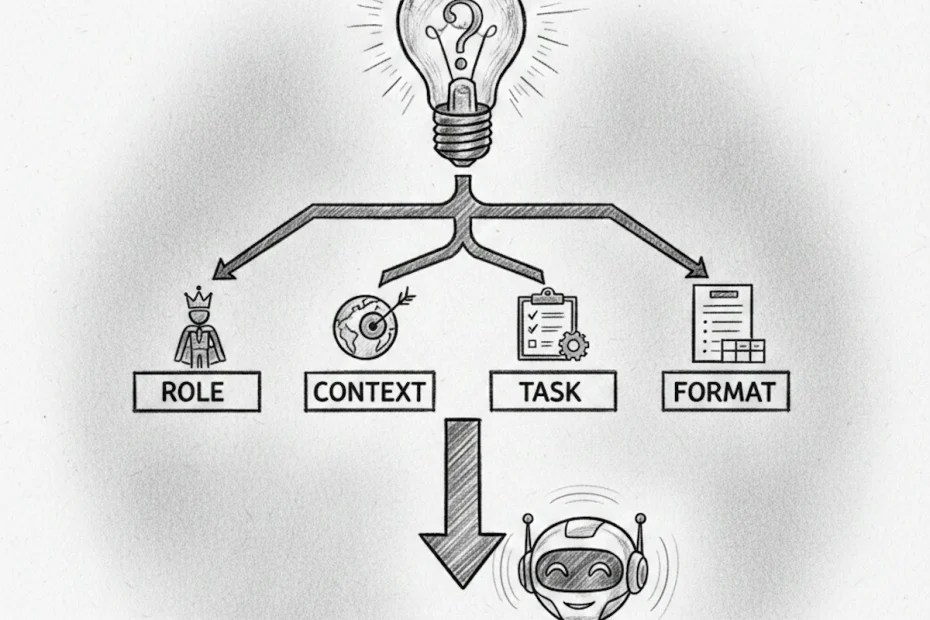
The magic formula: The R-C-T-F framework
To get a perfect result from the start, forget simple sentences. A professional prompt rests on four fundamental pillars. Imagine you are giving instructions to a very brilliant intern who knows absolutely nothing about your specific life or your hidden intentions.
1. The role (Who should the AI be?)
This is the most frequently neglected step. By assigning an identity to the AI, you unlock a specific vocabulary and a tailored tone.
- Weak Prompt: “Write a text about coffee.“
- Expert Prompt: “You are a neuroscientist specializing in the effects of caffeine on cognitive productivity.”
2. The context (Why and for whom?)
The AI needs to know the universe it is operating in. What is the goal? Who is the audience? What are the constraints?
- Example: “I am preparing a presentation for senior executives at a tech company who sleep very little and are looking to optimize their focus without sacrificing their long-term health.”
3. The task (What exactly should it do?)
Be direct and use action verbs. Avoid vagueness at all costs.
- Example: “Write a 300-word summary explaining the concept of the ‘adenosine window’ and propose an ideal coffee consumption protocol for a 10-hour workday.”
4. The format (How should the result look?)
This is where you save precious formatting time. Specify the structure, the length, and the visual style.
- Example: “Use bullet points for the protocol, adopt a professional yet punchy tone, and conclude with an inspiring quote from a famous biohacker. Do not include any unnecessary introductory fluff.”
Related: Vibe coding: The art of coding by instinct
Anatomy of a “Super-Prompt”: A practical comparison
Let’s look at the difference between a standard request and an “engineered” one.
The amateur approach:
If you simply say, “Give me a diet plan,” the AI will provide a generic list of vegetables and chicken that could apply to anyone. It lacks specificity, goals, and personal constraints.
The expert approach:
If you say, “Act as a sports nutritionist. I am a 40-year-old runner preparing for my first marathon. Write a 7-day meal plan focused on carb-loading. Present this as a structured list with caloric breakdowns for each meal,” the result is entirely different. You receive a precise, calculated, and professional program that is ready to be implemented.
3 Pro tips to refine your results
A. The “Few-Shot Prompting” technique
AI learns by example. If you want it to write like you, give it two or three examples of your style before asking it to write something new.
- How to do it: “Here are two examples of my previous articles: [Example 1], [Example 2]. Now, write a new article on [Subject] following exactly this tone and structure.”
B. “Chain of Thought” reasoning
For complex tasks (mathematics, strategy, coding), ask the AI to “think step-by-step.” This forces the AI to decompose its reasoning, which drastically reduces the risk of logical errors.
- How to do it: “Analyze this financial situation. Think step-by-step through the pros and cons before providing your final conclusion.”
C. The self-criticism loop
Before finalizing, ask the AI to evaluate itself. This simple trick adds a layer of quality control.
- How to do it: “Once you have written the text, critique it by looking for points that lack clarity and then provide an improved version based on that critique.”
The prompt is your new code
Prompt Engineering is not an exact science; it is a communication skill. The more structured you are in your thinking, the more powerful the AI will be in its execution.
By systematically using the Role, Context, Task, and Format model, you are no longer just “asking questions”, you are commanding cutting-edge technology.
To discover more AI tips and tricks, visit our page where we share the best advice and tutorials.