

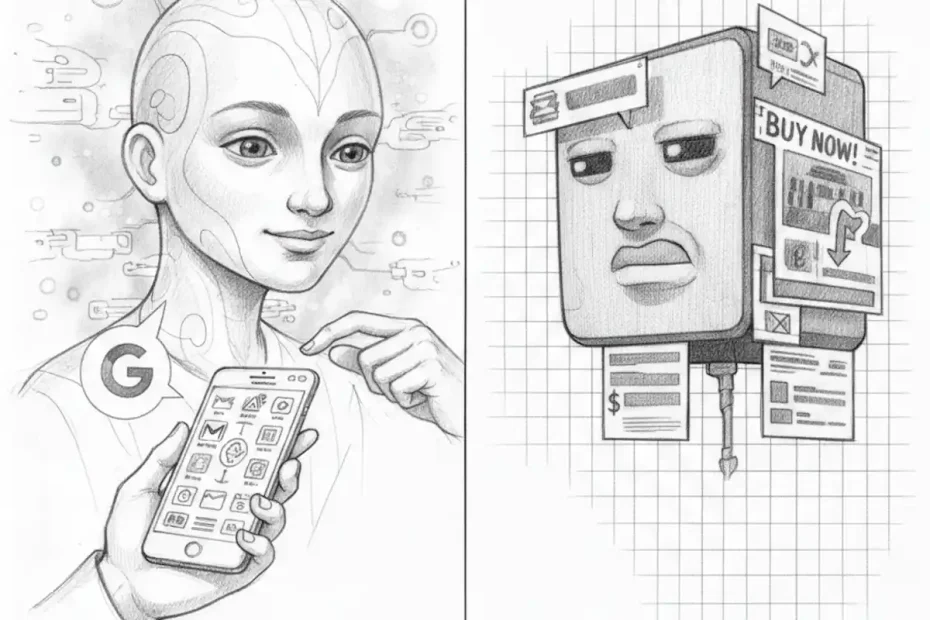
The Davos World Economic Forum is more than just a stage for geopolitical debate; it is where the future of our interactions with artificial intelligence is being mapped out. Recently, a clear divide has emerged between two industry titans: Google DeepMind and OpenAI. At the heart of the disagreement lies the imminent arrival of advertising within GPT-5.
A monetization strategy Google considers premature
The announcement sent shockwaves through the tech world: OpenAI plans to leverage its massive audience of 800 million weekly free users by integrating advertisements. For Demis Hassabis, CEO of Google DeepMind, this move is happening far too soon.
“I’m a little surprised they’ve taken the step this early,” he told Axios.
While Hassabis does not dispute that advertising has been the historical engine of the modern internet, he emphasizes a crucial nuance: a conversational agent is not a traditional search engine. While a banner on Google Search might be seen as a helpful response to a specific purchase intent, an ad in the middle of an AI exchange could be perceived as an intrusion into a private sphere.
AI: Life companion or billboard?
The vision defended by the DeepMind chief rests on the very nature of the user-machine relationship. He likens AI to an “intimate assistant” responsible for organizing one’s daily life. This distinction is fundamental:
In traditional search, users often express a clear intent to buy or discover, making contextual ads relevant.
With an AI assistant, the interaction is deeper. The sudden appearance of a commercial message in the middle of a personal conversation risks breaking the bond of trust, a scenario reminiscent of Amazon’s struggles with Alexa, where monetization attempts led to significant user pushback.
Related: OpenAI’s strategic pivot toward ad-supported intelligence
Google’s strategy: Loyalty before revenue
While OpenAI tests its first ad placements, Google is playing the long game. The current strategy for Gemini focuses on building tool dependency through extreme personalization. By connecting the AI to a user’s personal ecosystem—including Gmail, Photos, and YouTube—Google aims to make its assistant indispensable.
According to Demis Hassabis, Google’s leadership is not pressuring him to force advertising into Gemini just yet. The priority remains clear: refining the understanding of user needs to build a robust “personal intelligence” before risking that relationship for commercial gain.






Pingback: Technological Sovereignty: Microsoft Strengthens Infrastructure with Maia 200 Chip