

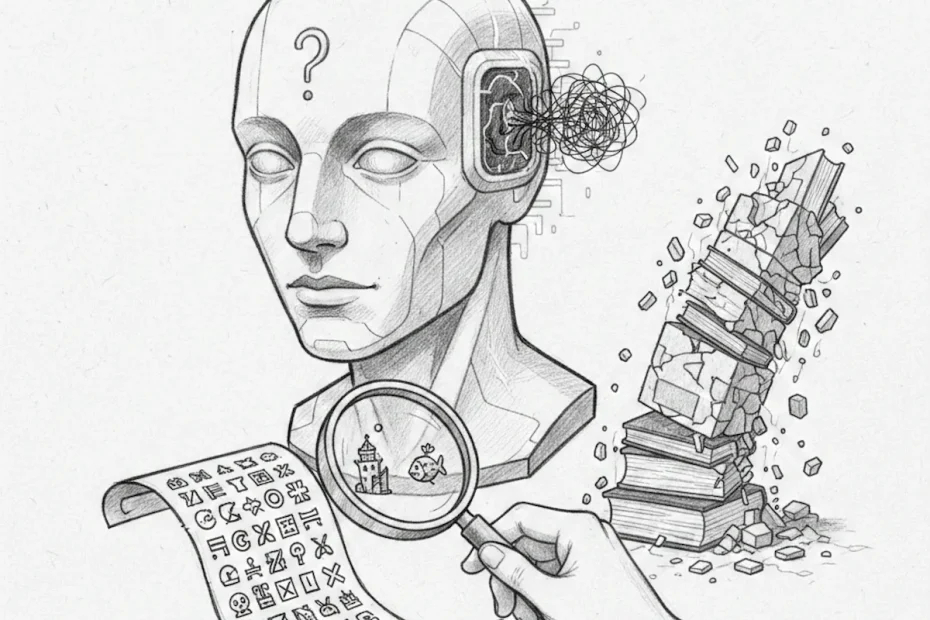
It is often imagined as a living, infallible encyclopedia, but at its core, GPT-5 remains an extremely sophisticated probability engine. While it revolutionizes the way we work, it possesses a very “human” flaw: it can sometimes have blind confidence in completely erroneous information.
Here is how to understand its limits and, more importantly, how to become an expert at verifying the accuracy of its responses.
Why does such a powerful AI make errors?
Even with cutting-edge architecture, GPT-5 does not possess a “consciousness” of truth. It operates through statistical prediction.
- Pure hallucination: Sometimes, to fill a gap in its data, the AI invents a response that sounds perfectly credible. It might cite a book that doesn’t exist or invent an imaginary physical law.
- Confirmation bias: If you ask a leading question (e.g., “Explain to me why the moon is made of cheese”), the AI can sometimes fall into the trap and follow your absurd logic just to be helpful, rather than contradicting you.
- Memory limits: During very long conversations, the model can sometimes lose track of a crucial detail mentioned at the very beginning.
3 red flags that should alert you
Learn to spot these linguistic “tics” that betray the model’s hesitation:
- The “Vague Speak” style: If the response suddenly becomes very broad or generic and overuses logical connectors without providing specific facts (names, dates, figures), the AI is likely “winging it.”
- Excessive politeness: An AI that apologizes repeatedly or uses excessive oratorical precautions before providing complex info is often on shaky ground.
- Internal contradiction: Read carefully. Sometimes the AI will state “A” in the first paragraph and imply “not-A” at the end of its response. This is a sign of a break in its chain of reasoning.
How to verify and challenge the AI
Don’t stay passive in front of the screen. Here is how to turn your dialogue into a real audit session:
The immediate “Cross-Examination”
Once GPT-5 has given you important information, don’t change the subject. Immediately ask: “What are the actual sources for this information, and can you present an argument that proves the opposite of what you just said?” This forces the model to switch from automatic generation mode to critical mode.
The decomposition technique (Chain of Thought)
For complex subjects (math, code, law), don’t ask for the final result all at once. Ask it: “Break down your reasoning step-by-step.” If an error slips in at step 2, you will see it immediately, whereas it would be invisible in a global result.
Related: How to use Chain of Verification (CoVe) to eliminate AI errors
The “New Page” test
If you have a serious doubt, open a completely fresh discussion and ask the same question without providing the previous context. If the AI gives a different answer, it means the information is unstable or misunderstood by the model.
The final word: You are the pilot
Artificial intelligence is an assistant, not a final judge. The more technical or recent the subject, the higher your vigilance should be.
Use GPT-5 to structure your ideas, translate, or synthesize, but always keep a traditional search engine or a reference book handy to validate crucial data.









Pingback: Elon Musk vs. OpenAI: The ultimate showdown for the throne of AI
Pingback: ChatGPT Down? Why AI glitches and how to access the best GPTs for free