
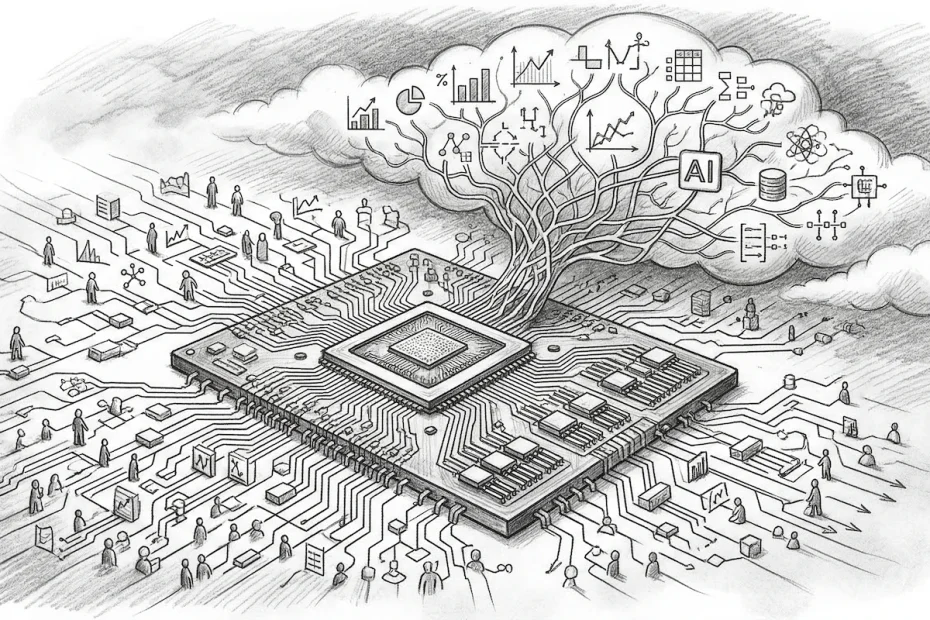
If artificial intelligence were a race car, the algorithms would be the steering wheel and the data would be the fuel. But for the vehicle to move at lightning speed, it needs an extraordinary engine. That engine is the GPU.
Long overshadowed by traditional processors, the GPU has now become the centerpiece of the world’s most powerful data centers. But what exactly makes this chip so special for AI?
1. Definition: From video games to artificial intelligence
The term GPU stands for Graphics Processing Unit. Originally, as the name suggests, this chip was designed for a very specific task: displaying complex images and fluid animations on our screens.
In a video game, every pixel on an image must be calculated dozens of times per second. This requires performing thousands of small mathematical calculations simultaneously. It is this innate capacity for parallel computing that made the GPU the ideal candidate for artificial intelligence.
2. Why does AI need GPUs?
To understand the importance of the GPU, we must compare it to the CPU (Central Processing Unit), the main “brain” of your computer.
- The CPU is a swiss army knife: It is designed to handle varied and complex tasks sequentially (one after the other). It possesses a few extremely fast and “smart” computing cores.
- The GPU is an army of specialists: It possesses thousands of smaller, simpler cores. It cannot do everything, but it is capable of processing massive amounts of data all at once.
Deep Learning, which is the foundation of modern AI, relies on structures called neural networks. These networks perform billions of simple mathematical operations (mainly matrix multiplications).
Where a CPU would process these calculations one by one, the GPU processes them in entire blocks. For an AI training task, a GPU can be 10 to 100 times faster than a traditional CPU. Without it, training a model like GPT-5 wouldn’t take months, but decades.
3. How does it work in practice?
The secret lies in data throughput. Imagine you have to move a mountain of sand.
The CPU is like a luxury delivery truck: very fast, capable of making complex decisions on the road, but it can only carry one bin at a time. The GPU, on the other hand, is a fleet of 1,000 workers with simple wheelbarrows. Although each wheelbarrow moves slower than the truck, the combined effort moves the mountain much faster.
In the AI universe, this “mountain of sand” corresponds to the model’s parameters. The larger the model, the more “weights” there are to adjust, and the more indispensable the GPU’s massively parallel architecture becomes.
4. A concrete example: Image generation
Take the example of an AI image generator like Midjourney or DALL-E. When you type a prompt (e.g., “An astronaut riding a horse on Mars”), the AI must transform text into millions of colored pixels.
- Analysis: The model breaks down your sentence into numerical vectors.
- Creation: To create the image, the AI starts with “noise” (a cloud of random dots) and must calculate, for every single pixel, what color it should take to look like an astronaut.
- The GPU’s role: The GPU processes the 2 million pixels on your screen simultaneously. It adjusts colors and shapes in a fraction of a second thanks to its thousands of cores.
If you tried to do this with a classic CPU, you would see the image appear line by line, very slowly, like an old 1990s dial-up internet connection.
Related: Free Midjourney alternative 2026: Create unlimited AI images with FAIO
5. The future: GPUs designed exclusively for AI
Today, manufacturers (like NVIDIA with its H100 chips or AMD) no longer settle for just recycling graphics cards for AI. They are creating Tensor Cores, specialized computing units housed inside the GPU, specifically optimized for the mathematical operations of neural networks.
The GPU has become much more than just a card for visual rendering. It is the physical infrastructure that allows humanity to process volumes of data that were once unimaginable, paving the way for ultra-precise medical diagnostics, autonomous driving, and increasingly human-like virtual assistants.