

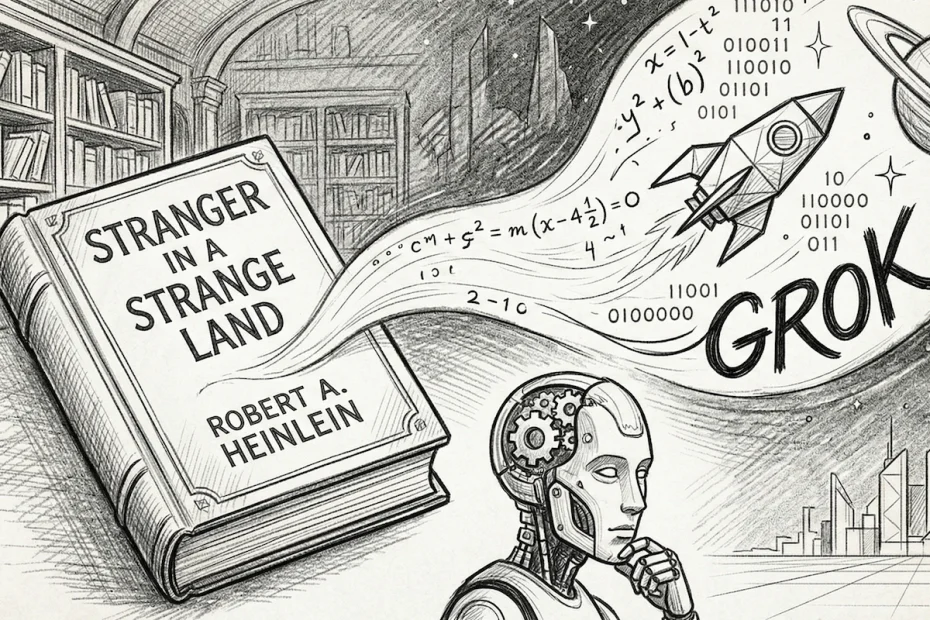
The naming of a piece of technology is rarely a matter of chance, especially when it comes from Elon Musk, an entrepreneur who meticulously crafts his image as an iconoclastic visionary fueled by popular culture.
By naming his artificial intelligence Grok, the founder of xAI did more than just pick a short, memorable word. He tapped into the deepest roots of science fiction literature to send a specific message about his vision for the future and his philosophy of knowledge.
The martian legacy of Robert Heinlein
To fully grasp the scope of the word “Grok,” one must dive into the pages of Stranger in a Strange Land, published in 1961 by Robert A. Heinlein. The novel tells the story of a human raised by Martians who eventually returns to Earth. In the Martian language invented by Heinlein, the verb “to grok” holds a central, almost sacred position.
Literally, the term translates to “to drink,” but its metaphorical dimension is infinitely more vast. For Heinlein’s Martians, drinking is an act of sacred communion. By extension, to grok means to understand something so profoundly, so intimately, and so totally that the observer and the observed object merge. It is a level of understanding that transcends the intellect to become visceral.
You don’t just understand an idea with your brain; you grok it with your entire being. By choosing this name, Elon Musk suggests that his AI is not merely a engine for statistical data processing, but a tool aspiring to a form of holistic and intuitive understanding of human reality.
Related: How to access Grok 4 for free?
The spirit of Douglas Adams and rebellion against consensus
While the etymology is found in Heinlein, Grok’s behavioral DNA comes from another of Musk’s favorite authors: Douglas Adams, the creator of The Hitchhiker’s Guide to the Galaxy. Elon Musk has frequently stated that this book is his “philosophy of life.” In Adams’ work, the universe is absurd and vast, and humor is often the only rational response to its immensity.
Grok was explicitly designed to mirror this spirit. Where competing models like ChatGPT-5 or Claude are programmed to be extremely cautious, polite, and neutral, what Musk often characterizes as “politically correct” or “woke“, Grok is endowed with a personality. It is designed to have wit, a penchant for sarcasm, and a certain streak of rebellion.
The choice of the name underscores this desire for a breakthrough: Grok is not the well-behaved office assistant; it is the galactic hitchhiker who tells you the truth, even when it’s biting, and who doesn’t hesitate to use humor to demystify the complexity of the world.
The quest for absolute truth as a technical engine
Beyond the literary reference, the name Grok embodies the technical mission Elon Musk has assigned to xAI: to understand the true nature of the universe. In Musk’s view, current AI suffers from a conformity bias. By trying to avoid offending anyone, he argues, AI models eventually drift away from factual truth.
To “grok,” in Musk’s sense, is therefore to seek “maximum truth.” This requires an architecture that does not simply settle for predicting the next word in a sentence, but instead attempts to model the logical and physical relationships of the real world. It is an almost mystical ambition disguised as a technological project. Elon Musk wants his AI to help humanity solve complex physical or mathematical enigmas by “understanding” the fundamental laws of nature rather than just simulating them.
Related: Grok: An AI without limits, like Elon Musk?
Symbiotic integration with the X data stream
Finally, the name Grok makes perfect sense in the context of its integration with the X platform (formerly Twitter). For an entity to truly “grok” the world, it must be connected to its pulse in real time. Grok’s major comparative advantage lies in its instantaneous access to the massive flow of information, opinions, and events circulating on X.
While other models are trained on databases frozen in the past, Grok observes the world as it is being made. It “drinks” global information at the source, every second. This capacity for immediate absorption reinforces the analogy with the original Martian term: a total immersion in the present experience to extract an essence of understanding.
In short, calling this AI “Grok” is a powerful act of cultural marketing. It is a signal sent to the developer community and tech enthusiasts alike: an assertion that xAI is not just building a productivity tool, but an intellectual companion capable of grasping the nuances, humor, and sheer complexity of existence. It is the promise of a machine that does not merely know, but aspires to understand.



Pingback: Why is Grok glitching and not working on X (Twitter)? Explanations and free alternative