
The Oakland Federal Court has become the stage for a major judicial duel that could redefine the future of global technology. Elon Musk, a founding member of the project, is now suing Sam Altman and Microsoft, accusing the organization he helped build of betraying its founding ideals.
From philanthropy to profit
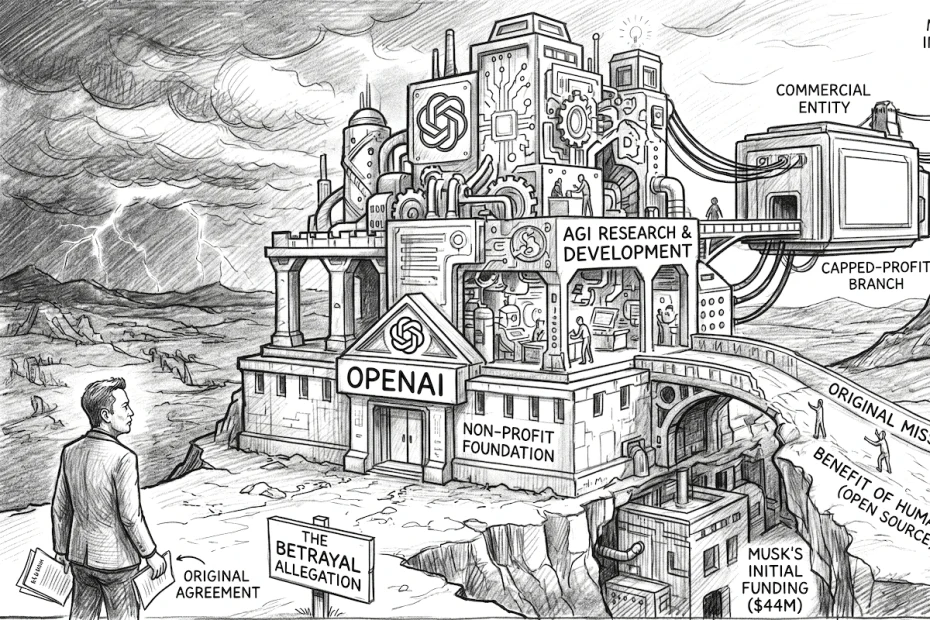
At the heart of the dispute, Elon Musk denounces a radical metamorphosis. OpenAI, born in 2015 as a non-profit foundation dedicated to the benefit of humanity, has allegedly transformed into a closed commercial entity under the influence of Microsoft.
The billionaire, who injected approximately $44 million into the initial structure before his departure in 2018, believes that this pivot toward profit-seeking constitutes a breach of the moral contract made with donors and the public.
The financial pivot and the counter-attack
To fund the colossal computing power required to develop models like GPT-4, Sam Altman established a “capped-profit” branch in 2019. This structure allowed the organization to attract massive investments from Microsoft, estimated at $13 billion.
In response to these accusations, OpenAI chose to fight back by releasing old emails. These documents suggest that Elon Musk himself had once supported the idea that the organization needed to raise billions of dollars to compete with giants like Google. The archives even show that the Tesla CEO had previously proposed taking full control of the entity or merging OpenAI with his automotive company.
Related: ChatGPT Down? Why AI glitches and how to access the best GPTs for free
The crucial question of AGI
The conflict also hinges on a contractual subtlety regarding Artificial General Intelligence (AGI). The partnership with Microsoft specifically excludes technologies that reach this stage of human-level reasoning. Elon Musk contends that GPT-4 already represents a form of AGI, which would imply that OpenAI is intentionally concealing its breakthroughs to maintain its commercial agreements instead of making its discoveries public.
An existential stake
Beyond the feud between executives, Elon Musk positions himself as the guardian of the American charitable model. He asserts that if OpenAI is not held accountable, it could set a precedent allowing any philanthropic work to be plundered and converted into a private corporation.
Ultimately, this lawsuit illustrates Musk’s ambivalent vision of artificial intelligence. He views it as a tool capable of the best outcomes, such as eradicating diseases, but also as an existential threat that could lead to human extinction if guided solely by the pursuit of profit.