

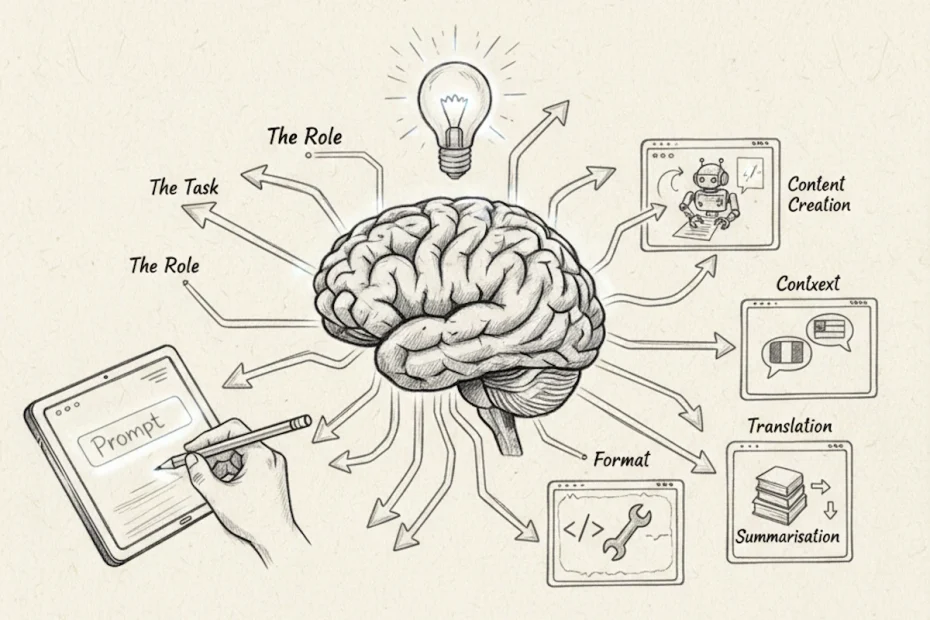
If you have used Free AI Online, you have already experienced a fascinating interaction: you type a sentence, and an AI responds with staggering relevance. This sentence is what we call a Prompt.
In the previous entry of our AI Glossary, we explored the inner workings of LLMs (Large Language Models). To use an analogy: if the LLM is the ultra-powerful engine of a racing car, the prompt is the steering wheel. Without precise direction, even the world’s most advanced technology cannot lead you to your desired destination. Understanding the prompt means moving from being a mere spectator to becoming the conductor of the AI’s vast potential.
1. Technical definition: The natural language interface
A Prompt is the input unit that serves as the starting point for a generative AI model. Historically, communicating with machines required rigid binary code or complex programming languages.
The revolution of LLMs lies in the fact that prompts are expressed in Natural Language. It is a textual instruction that encapsulates the user’s intent. However, unlike a standard human conversation, every single word in a prompt mathematically influences the probabilities of the response the AI will generate. A prompt is not just a question; it is a set of parameters that reshapes the AI’s internal logic for a specific task.
2. The role of context: Narrowing the probability space
A LLM possesses immense but “flat” knowledge. Without a precise prompt, it floats in an ocean of data.
- The vague prompt: If you ask “Tell me about cooking”, the AI must choose between the history of gastronomy, pasta recipes, or kitchen plumbing. It will likely provide a generic, average response.
- The structured prompt: By specifying “Provide a traditional Italian gluten-free recipe for four people”, you create a “probability tunnel”. The prompt acts as a filter, forcing the AI to ignore 99.9% of its irrelevant data to focus solely on what brings you value.
3. The anatomy of an expert prompt
To achieve high-precision results on our platform, I recommend structuring your prompts following a specific information hierarchy:
A. The persona (Who is the AI?)
This is one of the most powerful levers at your disposal. By defining a role, you activate a specific subset of vocabulary and logic.
- Example: “Act as a sports nutritionist specialising in marathon preparation.”
- Effect: The tone becomes technical, rigorous, and performance-oriented.
B. The task (What is the action?)
Use strong imperative verbs. Be explicit about the final objective.
- Example: “Analyse these medical results“, “Draft a formal report“, or “Synthesise these conflicting arguments“.
C. Context and audience (For whom?)
The AI needs to know who it is talking to in order to adapt its level of complexity.
- Example: “Explain how an internal combustion engine works for a 10-year-old child.”
D. Format and Constraints (How?)
This is where you define the structure of the output.
- Example: “Present the result as a comparative table“, “Maximum 150 words“, “Do not use technical jargon“, or “Respond only in JSON format“.
4. Introduction to Prompt Engineering
Prompt Engineering is the discipline of testing, refining, and optimising these instructions. It is not an exact science, but an empirical method of trial and error.
Among advanced techniques, we find “Chain of Thought” reasoning. By simply adding the phrase “Think step-by-step” to your prompt, you force the LLM to decompose its reasoning process. This drastically reduces logical errors and “hallucinations”, as the AI verifies each segment of its thought process before producing the final result.
5. Why mastering the prompt changes your productivity
On Free AI Online, we provide access to world-class models like GPT-5.2 and Grok-4. However, the difference between a “correct” result and an “exceptional” one lies entirely in your ability to formulate your request. Mastering the prompt is about learning how to intelligently delegate complex tasks to a machine, freeing up your time for higher-level creativity and strategy.









Pingback: Master the art of prompt engineering: The ultimate guide to the R.C.T.F. framework
Pingback: How to inject style and credibility into AI-Generated content ?
Pingback: What is Prompt Chaining? A complete guide to mastering AI workflows
Pingback: The ultimate free Jasper AI alternative: Write smarter without the monthly bill