

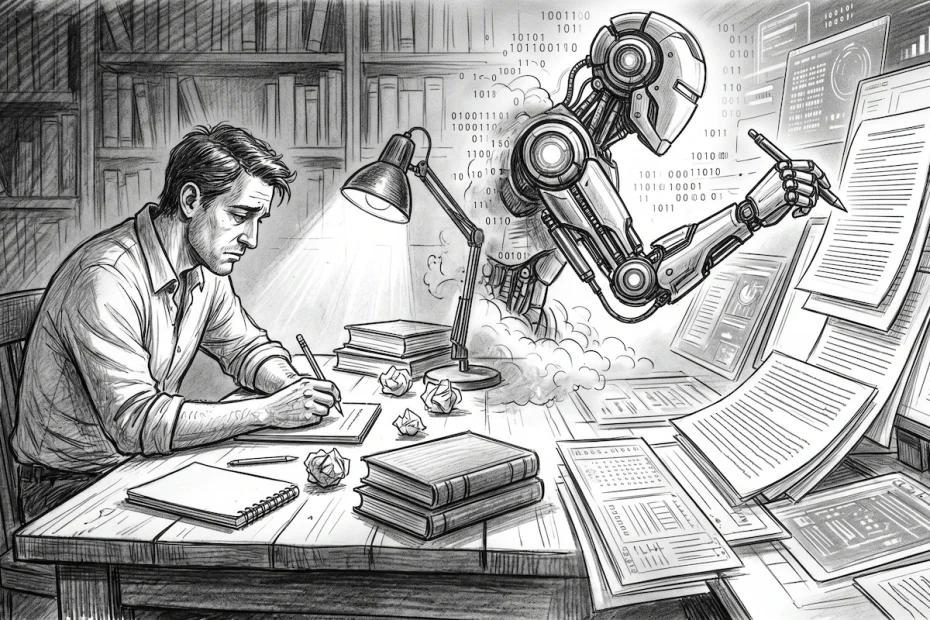
The debate is no longer about if artificial intelligence will disrupt the writing world, but rather how much damage it has already done to professionals in the industry. For years, content creators brushed off the threat, convinced that the “human touch,” emotional depth, and true creativity would remain our species’ impenetrable fortress.
Today, in the face of breathtaking technological leaps, that optimistic narrative is collapsing. The future of the writing profession isn’t just being shaken up, it is in critical danger.
The current seismic shift: What’s already happening in the market
Let’s face reality. In marketing agencies, digital newsrooms, and freelancing platforms, the landscape has radically shifted. Writers who specialize in “low-to-mid value” content, like product descriptions, blog posts, and social media copy, are watching their workloads evaporate.
Why would a company pay hundreds of dollars for an article that takes two days to write when an algorithm can deliver the exact same thing in three seconds for the price of a cheap monthly subscription?
Many industry professionals have already been forced to pivot or drastically slash their rates. Companies are no longer hiring junior copywriters to pump out first drafts; they are buying enterprise AI licenses. Most human writing work left on the market has devolved into simple proofreading, fact-checking, or keyword stuffing. We have transformed from wordsmiths into mere “machine supervisors.”
The economic shift has begun, and it is brutal.
Related: Which jobs will AI replace? Top 10 professions at risk in 2026
The New Masters of Content: ChatGPT-5, Grok, and Gemini
While early generations of large language models suffered from robotic phrasing and obvious patterns, today’s versions have crossed a phenomenal threshold. Tech giants have engineered tools that are terrifyingly flawless at generating content.
ChatGPT-5: OpenAI’s flagship no longer just predicts the next word; it thinks. By incorporating deep reasoning mechanisms, it effortlessly grasps complex tones, irony, empathy, and ultra-formal journalistic styles. For content creation, it has become pristine: the structure is airtight, the arguments flow seamlessly, and factual hallucinations have been drastically minimized.
Gemini: Developed by Google, this model shines in contextual analysis and native web integration. It can synthesize thousands of conflicting sources in the blink of an eye to write deeply researched long-form pieces, perfectly tailoring its vocabulary to any target audience.
Grok: Driven by xAI, Grok stands out for its real-time cultural awareness and sharp wit. It excels at writing punchy, agile content tied directly to breaking news, a skill set that used to belong exclusively to seasoned social media managers and trending-news reporters.
Related: Why is Grok glitching and not working on X (Twitter)? Explanations and free alternative
A grim outlook: Why the profession is in peril
What does the near future hold for the writing industry? The answer is painful: a massive contraction of the job market. As these AI models develop “agentic” capabilities, meaning the ability to independently research, outline, write, fact-check, and publish an entire content strategy without human intervention, the need for human writers will continue to wither away.
Competition will no longer be between human writers, but between corporations wielding the most advanced AI tech.
The only humans who will survive in this ecosystem belong to a tiny elite: brilliant copywriters capable of inventing revolutionary marketing concepts, or investigative journalists bringing exclusive, boots-on-the-ground reporting that can’t be scraped from the web. For everything else, mass content creation will be entirely automated.
The “human touch” argument is becoming a luxury that fewer and fewer businesses are willing to bankroll. When an AI can produce a piece that is 95% as good as a human’s work, for a fraction of a cent, in a heartbeat, bottom-line economics will win every single time. The traditional writer is, without a doubt, on the endangered species list.




Très bon article ! J’utilise Claude Fable 5 sur pour ce type de besoin