

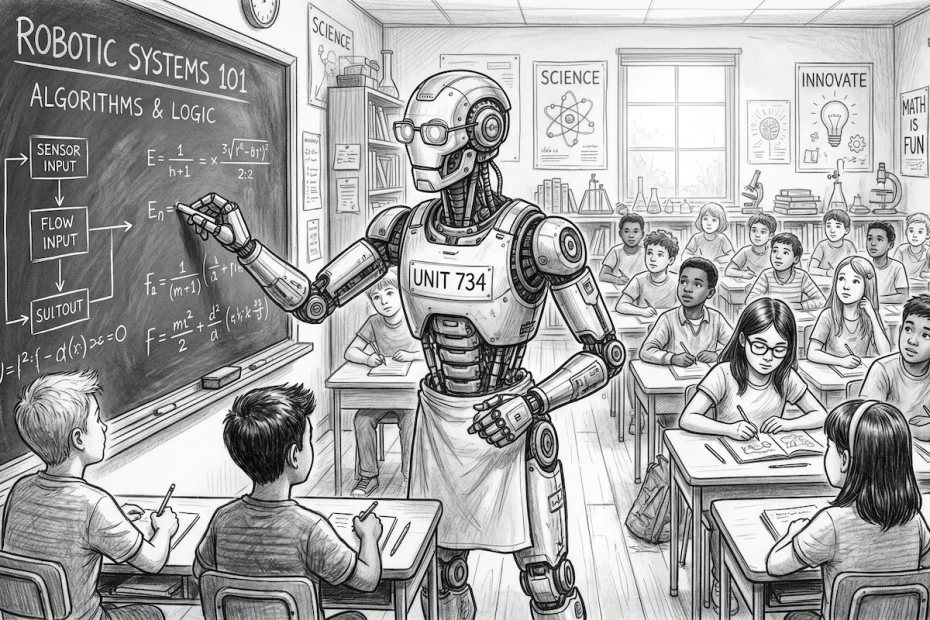
It is the great anxiety of our time. Since the explosion of advanced language models, virtual tutors, and adaptive learning tools, a crucial question has been stirring staffrooms, ministries of education, and family dinner tables alike: will AI replace teachers?
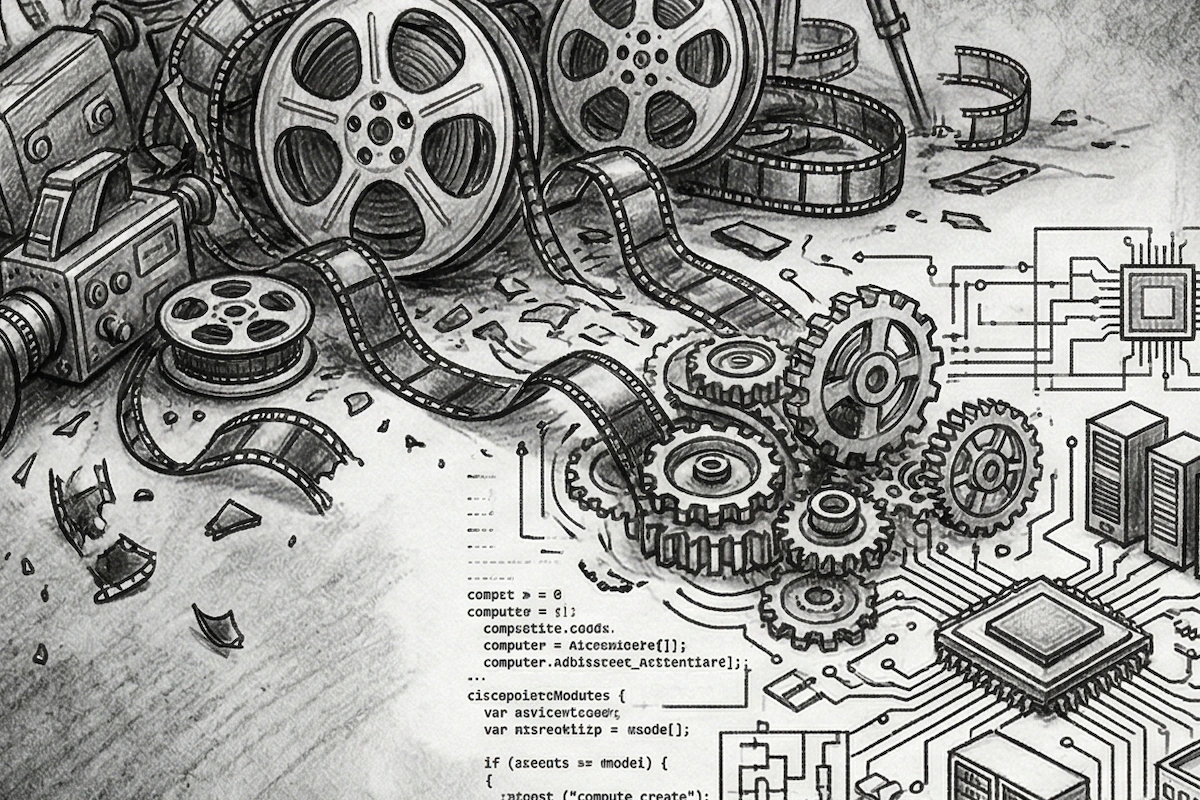
While some tech-enthusiasts already imagine sterile classrooms managed by omniscient algorithms and flawless holograms, the reality on the ground is far more subtle. Artificial intelligence is proving to be not a substitute, but a mirror held up to our educational system, forcing us to redefine what the act of teaching truly means.
Here is an in-depth look into a pedagogical revolution where machines are not displacing humans, but rather placing them back at the center of their true value.
Why is the question of replacement being taken so seriously?
To understand the fear, or hope, of replacement, one must look at the dizzying performance of current AI. Traditional education, inherited from the industrial era, often relies on a one-size-fits-all model: one teacher facing about thirty students, delivering the same knowledge, at the same moment, at the same pace. This is the mass-broadcast model.
AI disrupts this centuries-old paradigm through three extraordinary capabilities.
- First, the hyper-personalization of learning.
An AI is capable of analyzing in real time a student’s strengths, weaknesses, memorization pace, and even attention span. If a child gets stuck on fractions or subjunctive conjugation, the algorithm instantly adapts the explanation, changes the angle, offers a visual diagram or a textual metaphor, and does so until the concept is fully mastered. No human teacher, no matter how dedicated, can offer this level of tailor-made attention to thirty different students simultaneously.
- Second, total availability.
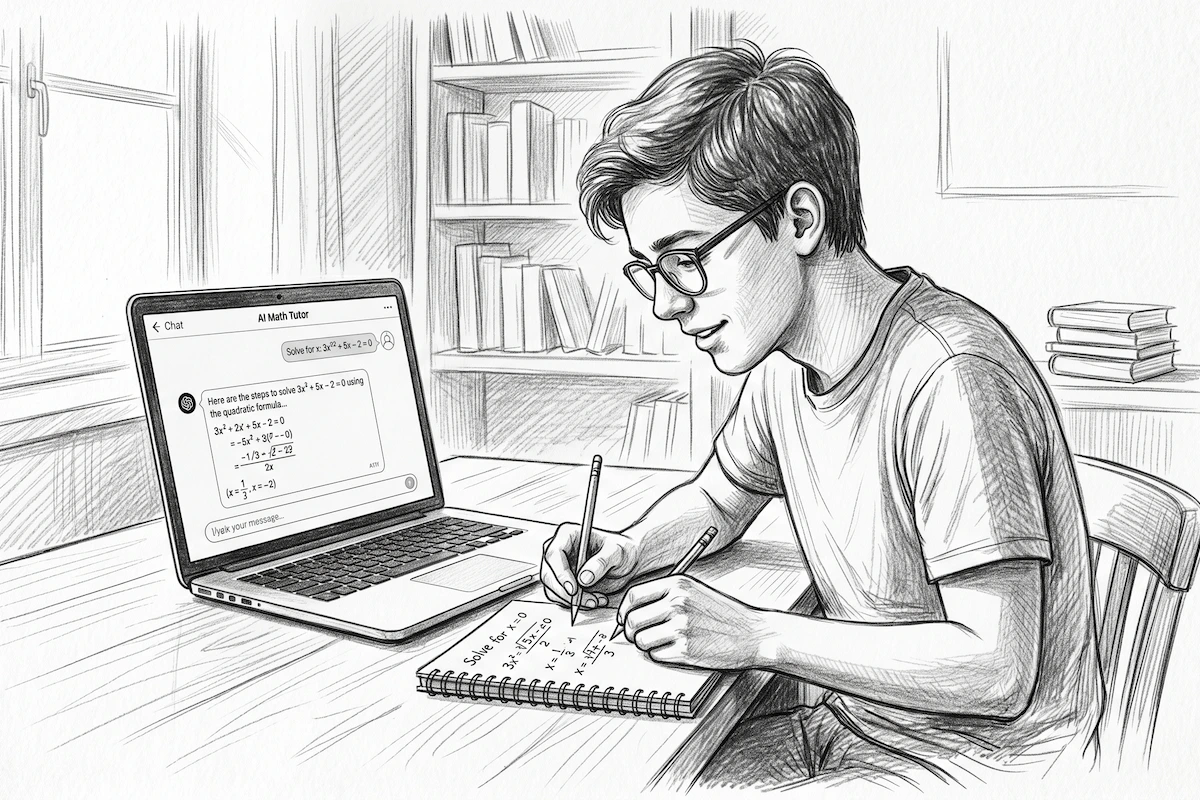
An AI never sleeps, never tires, never experiences burn-out, and never loses patience. It is accessible at midnight on the eve of an exam or at six in the morning, offering free and universal academic support to those who cannot afford the services of a private tutor.
- Finally, instant access to and synthesis of global knowledge.
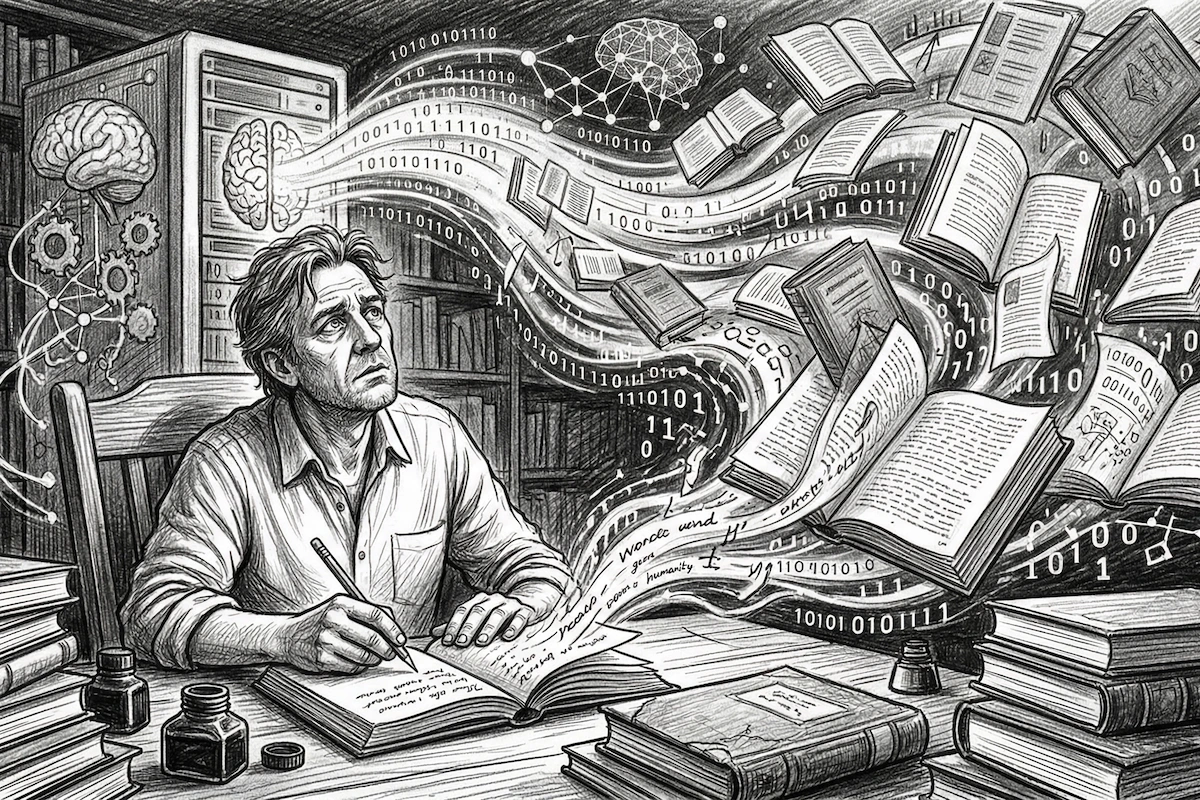
AI is not just a living encyclopedia; it can cross disciplines, translate a complex concept into simple language for a ten-year-old, or generate lines of code to illustrate a physics lecture. Faced with such raw cognitive power, the economic and political temptation to streamline costs by replacing the blackboard with a connected screen is a reality that cannot be ignored.
Related: Which jobs will AI replace? Top 10 professions at risk
What AI already does better than humans: Ending thankless tasks
Let’s be clear: AI will replace a portion of teachers’ activities. And this is actually excellent news for the teaching profession. Teachers today suffer from administrative overload and a chronic lack of time to care for their students individually. The machine targets precisely this burden.
The automation of invisible work
A teacher spends an average of one-third of their working time outside the classroom: grading endless stacks of papers, designing worksheets, filling out grading software, writing report card comments, or preparing lessons that comply with non-stop curriculum reforms.
Today, generative AI tools accomplish these tasks in seconds. A teacher can ask an AI to design a differentiated quiz with three levels of difficulty on the mechanics of climate change or ecosystems biodiversity based on a specific text, and generate the grading rubric for it. Automatic evaluation systems are already capable of grading spelling tests or complex math exercises while explaining the exact logic of the mistake to the student.
Putting “differentiated pedagogy” into practice
The great tragedy of mass education is the obligation to target the “middle” of the class, at the risk of losing struggling students and boring advanced ones. Here, AI acts as a high-level pedagogical assistant. It relieves the teacher of the raw, mechanical transmission of knowledge and the repetition of basic exercises. By managing student practice, it restores the teacher’s most noble role: that of a designer of learning strategies.
The absolute limits of the algorithm: Why humans remain irreplaceable
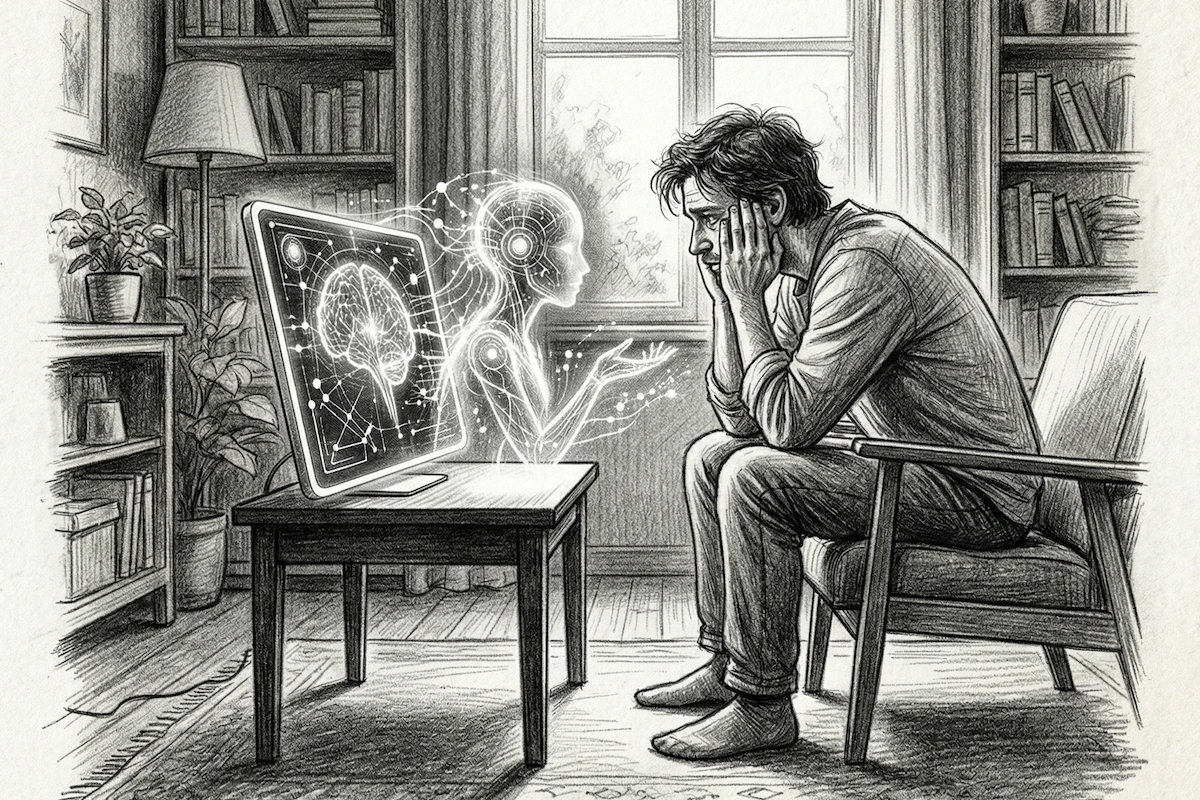
Despite its extraordinary capacity for processing information, AI suffers from a major handicap: it feels nothing, experiences nothing, and does not understand the human condition. Learning is not a simple transfer of data files from a computer to a biological brain. It is a deeply emotional, relational, and social process.
Emotional intelligence and decoding non-verbal cues
An AI can detect that a student has failed an algebra exercise three times in a row. What it cannot see is that this student’s eyes are tearing up because their parents are going through a divorce, they are being bullied in the schoolyard, or they are simply hungry.
The teacher, however, senses the imperceptible. They read faces, interpret a heavy silence, a slumped posture, a sigh. They know instinctively when to raise their voice to re-engage the class, when to whisper a word of encouragement to a doubting student, or when to interrupt the lesson to open the window and let everyone breathe. Empathy cannot be aligned in lines of code.
The school as a micro-society and citizenship training
We often forget that school’s sole mission is not just to fill heads with formulas and dates. Its primary mission is to build citizens. It is at school that we learn to live together, to negotiate, to share, to respect the words of others, and to manage conflicts peacefully.
AI gives ready-made answers; the teacher, however, teaches how to ask the right questions and how to doubt the obvious.
Debating ideas in class, the collective emulation when a group of students solves a difficult problem, the loud burst of shared laughter after a clumsy mistake, these moments of pure human connection are the glue of memorization and socialization. A machine can simulate politeness, but it will never transmit values or ethics.
The engine of motivation: inspiration and mentorship
If you take a moment to recall your own schooling, you won’t think of textbooks or software. You will think of two or three faces. That English teacher who made you love poetry, or that biology teacher who sparked your vocation to become a doctor.
Students do not learn for data; they learn, at least initially, to please an adult they respect, to shine in the eyes of a mentor, or because they are magnetized by someone’s passion. No one hesitates to disappoint a digital interface or to cheat against an algorithm. However, cheating in front of a teacher who believes in you carries a moral cost that young people are not always willing to pay. Passion is a contagious condition that is only transmitted from human to human.
Related: The ultimate guide to solving Math with Free AI Online
The concept of the “Augmented” teacher: Toward an inevitable alliance
The debate must therefore not be framed in terms of a clash (Man vs. Machine), but in terms of collaboration. The real revolution is not the replacement of the teacher, but their metamorphosis into an “augmented teacher.”
In the future, teachers who refuse to use AI will not be replaced by machines, but they will indeed be overtaken by teachers who know how to use them.
In this school of tomorrow, roles will be redistributed more intelligently. The machine will take over the most mechanical and quantitative dimensions of teaching: assessing basic knowledge, repetitive practice, collecting data on student progress, and creating diverse educational materials.
Freed from these time-consuming tasks that drain their daily energy, teachers will be able to make a historic shift in posture. They will leave behind their traditional role of vertical knowledge disseminator, the “sage on the stage”, to become a guide, coach, and facilitator, the “guide by your side.” Their precious time will be reallocated to what AI can never do: orchestrating collaborative projects, leading philosophical debates, stimulating creativity, developing students’ critical thinking against the fake news spread by… AIs themselves, and offering tailor-made psychological and human support to the most vulnerable profiles.
AI, the best ally for the future of education
So, will AI replace teachers? The answer is a categorical no. Education is, at its core, a human relationship industry. You do not educate a child the way you program software.
However, standing still would be a fatal mistake. Schools cannot pretend to ignore the technological tidal wave without becoming completely obsolete in the eyes of new generations. Artificial intelligence will free the teaching profession from its administrative burdens to restore all its relational nobility.
The future of education belongs neither to radical technophobes nor to blind transhumanists. It belongs to that virtuous alliance where the algorithmic power of the machine finally serves the sensitivity, ethics, and pedagogical genius of the human being.




Pingback: How to make money with AI in 2026? 10 concrete (and realistic) ideas