
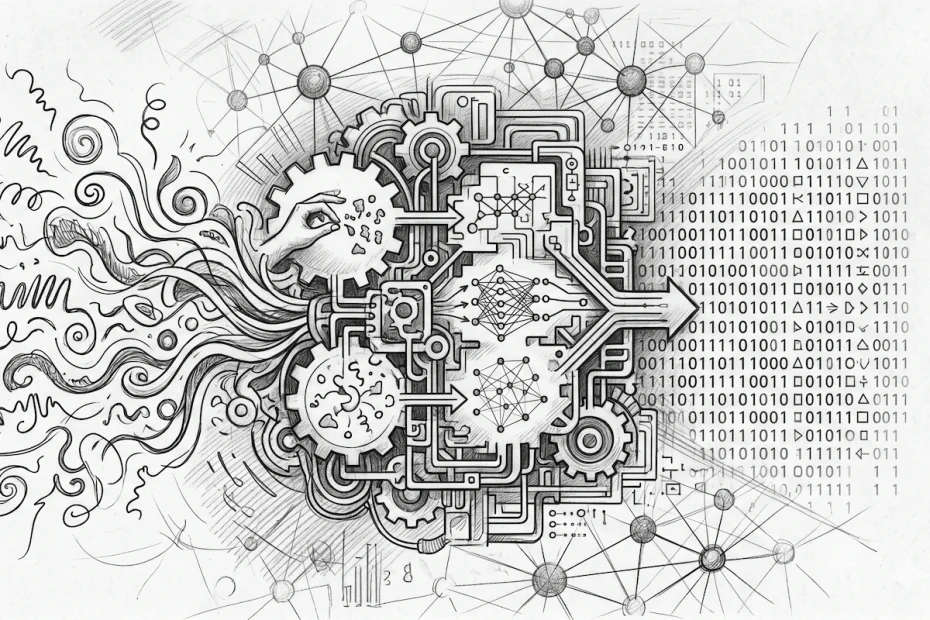
For decades, computing operated on a rigid, binary logic: for a machine to execute a task, it had to be given instructions coded with surgical precision. Humans, however, communicate with nuance, irony, metaphors, and sometimes approximate grammar. This is where NLP (Natural Language Processing) comes in.
This field, at the intersection of linguistics and computer science, aims to break the barrier between humans and machines by teaching the latter to “read,” “hear,” and “speak” fluently.
Why is it so complex for a machine?
Human language is naturally ambiguous. Take the sentence: “I saw the man with the telescope.” Did I use a telescope to see the man, or did the man have a telescope? For us, context usually settles the question in a fraction of a second. For a traditional AI, it is a logical puzzle.
NLP must solve three major problems:
- Lexical ambiguity: The same word can have several meanings (polysemy).
- Context: The meaning of a word depends entirely on those surrounding it.
- Implicitness and culture: Understanding sarcasm, slang, or cultural references.
The technical recipe: From word to vector
For a computer to process text, it must first transform letters into numbers. This is called vectorization. Imagine a massive multi-dimensional space where every word occupies a specific coordinate. Words like “dog” and “cat” will be placed very close to each other, while “microwave” will be far away.
Today, we have entered the era of Transformers. This revolutionary architecture allows the AI to analyze all the words in a sentence simultaneously (instead of reading them from left to right). Thanks to a mechanism called “Attention,” the AI can weigh the relative importance of each word.
In the sentence “The bank refused the loan because it was too cautious,” the attention mechanism allows the AI to instantly understand that “it” refers to the bank and not the loan.
Related: Master the art of prompt engineering: The guide to the R.C.T.F. framework
The two pillars: NLU and NLG
To fully grasp NLP, it is helpful to divide it into two complementary functions:
1. Natural Language Understanding (NLU)
This is the “listening” part. The AI breaks down the sentence, identifies entities (proper names, dates, places), and attempts to extract the intent. This is what happens when you ask a smart speaker to “play some jazz”: it must understand that “play” means “stream audio” and “jazz” is the genre filter.
2. Natural Language Generation (NLG)
This is the “speaking” part. Once the AI understands what is expected, it must construct a response that doesn’t sound robotic. It assembles words probabilistically to create a sentence that is coherent, elegant, and grammatically correct.
An invisible but omnipresent impact
While NLP is making headlines today with models like Gemini or ChatGPT, it has been integrated into our lives for a long time:
- Spam filtering: Your email client analyzes the content of your messages to spot suspicious phrasing.
- Universal translation: Being able to read a Japanese website in one click with near-perfect syntax.
- Sentiment analysis: Companies use NLP to scan thousands of web reviews to determine if customer feedback is generally positive or negative.
- Accessibility: Real-time speech-to-text transcription for the hearing impaired.
Related: Demystifying AI: Launching the Free AI Online Glossary
Conclusion
NLP is no longer just a matter of dictionaries stored in a database. It is a fascinating attempt to mathematically model human thought as expressed through words. By teaching machines to master our language, we are not just creating more efficient tools; we are creating partners capable of collaborating with us in our own primary mode of communication.
Would you like to dive deeper into the technical side of “word vectors,” or would you prefer to explore the current limitations of these technologies, such as AI hallucinations?